
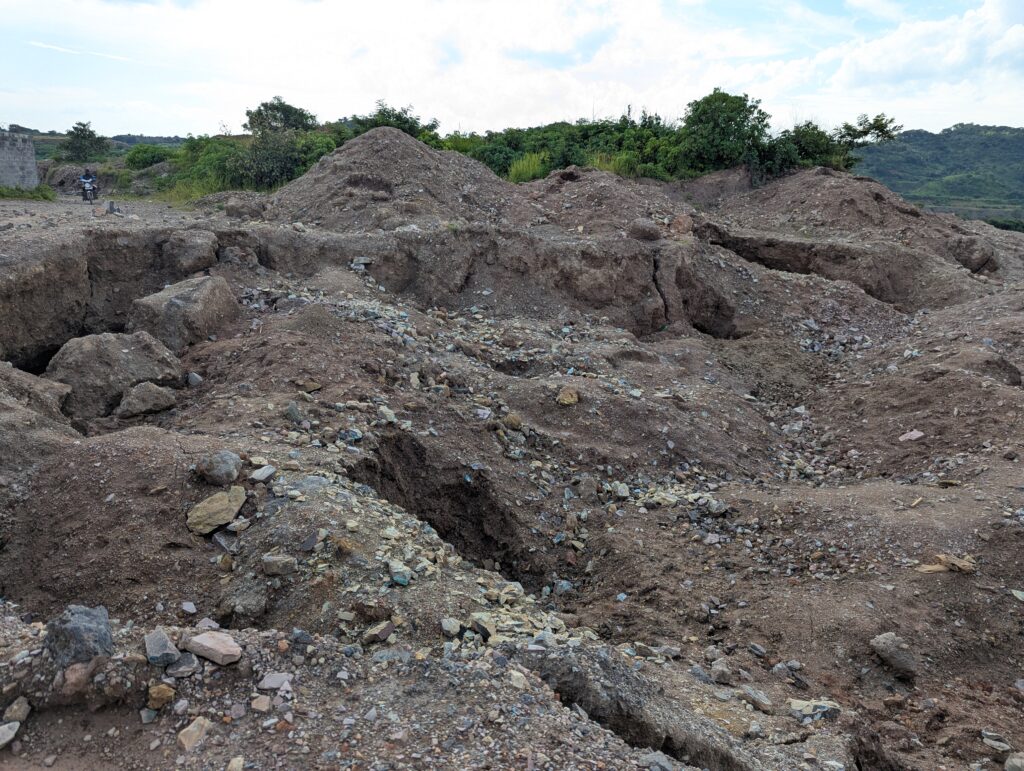

Community-managed forests in the DR Congo, meant to safeguard biodiversity and promote sustainable management, are under threat from expanding mining operations that encroach on dozens of concessions. For the DR Congo’s Great Apes—including the endangered bonobo and the Grauer’s gorilla—these forests are more than just land; they are vital corridors of survival. Caught between the need to protect the Congo Basin and the industrial drive for strategic minerals, the future of both the Congolese community forests and the apes that call them home hangs in the balance.
This story was first published by our sister initiative InfoNile. It was produced in partnership with the Pulitzer Center’s Rainforest Investigations Network.
By: Jonas Kiriko
Two years ago, the inhabitants of the Kyunga and Milando community forests woke up to the sound of machines operating in the heart of their lands, a dense rainforest in the southeastern part of the Democratic Republic of the Congo.
“These were machines installed by a mining company,” recounts Masangu Telesphore, a 51-year-old farmer. “They were digging a road to access the mine.”
In 2022, the community was entrusted with management of the forest, which hosts ancient trees sacred to the local community. In exchange for conserving most of the land, they were using another part to farm cassava, sweet potatoes and maize, conduct small-scale logging and produce charcoal: activities that supported over 5,000 people. But now, a major Congolese extractive company, Golden Sands Mining SARL, was moving in to mine cobalt, copper, gold and other minerals – without their knowledge or consent.
In the DRC, because 80% of intact forests lie outside of national parks, community forests serve as vital informal sanctuaries for Apes.
Jonas Kiriko
This episode shows how community forests and mining concessions overlap in the Democratic Republic of the Congo (DRC). The DRC, home to the world’s second-largest tropical rainforest, is the last refuge for endangered bonobos and Grauer’s gorillas. The global demand for minerals for clean energy and smartphones drives mining and illegal logging that destroy forests, cut ancient Great Ape migratory corridors, and threaten their vital role as gardeners of a climate-regulating ecosystem. In the DRC, because 80% of intact forests lie outside of national parks, community forests serve as vital informal sanctuaries for Apes.
A decade ago, community forestry was hailed as a panacea to the problems of extraction: a legal designation that could enable local communities to protect their forests while generating income through sustainable activities such as agroforestry and fishing. Since the country passed landmark laws establishing regulations on community forestry in 2014 and 2016, provincial governors have allocated more than 220 forest concessions covering nearly 4.5 million hectares to local communities for conservation and sustainable economic activities.
But despite these forests’ special protections, a yearlong investigation by InfoNile in partnership with the Pulitzer Centre’s Rainforest Investigations Network has found a significant chunk of the country’s active mining permits are encroaching on these forests. Nine percent of the land area under mining permits intersects community forests, particularly in the eastern provinces of South Kivu, North Kivu, and Haut-Katanga. This overlap covers a total of 4,250 square kilometres, roughly the size of 600,000 football fields.
The reverse is also true. In many cases, provincial governors working alongside non-governmental organisations have also helped communities establish forests on top of pre-existing mining concessions.
As mining companies come in and forest boundaries are blurred, some community members have started selling off other areas of the forests to timber exploiters and agro-industrial operators.
The opaque allocation of both mining licenses and community forests results from a legal vacuum and a lack of state oversight and accountability. According to Professor Alphonse Maindo, head of the sustainable forestry NGO Tropenbos International-DRC, there is no centralised information system to verify existing titles. This community forests expert urged the state to bring together mining, forestry, and agricultural stakeholders for joint planning.
“Multi-stakeholder roundtables on community forestry, at both the national and provincial levels, offer a unique opportunity to share maps, exchange knowledge, and find solutions together,” he said. “Many problems simply stem from this lack of access to information.”
Over 100 active mining permits overlap community forests
The mining sector in DRC has expanded rapidly in recent years, driven by rising global demand for critical minerals. Government mining cadastre data obtained by the Center for Advanced Defence Studies (C4ADS) reveals that 8.9 percent of Congolese territory, making up 214,000 square kilometres, is covered by mining permits. From east to west, north to south, concessions for industrial, semi-industrial and artisanal mining crisscross the country.
The DRC has fast become a major global player supplying critical minerals for electric vehicles, renewable energy, and modern technologies. It is the world’s largest producer of cobalt, supplying over 70 percent of global output, and ranks among the top producers of copper. The country also holds significant reserves of coltan, lithium, and tin. Most of these minerals are exported, mainly to China, along with Europe and North America.
The vast majority of mining takes place within the country’s dense rainforest. Covering more than 1.5 million square kilometres, DRC’s rainforest hosts many critically endangered species and plays a crucial role as a carbon sink. But when big mines come in, road building and forest clearing for farmland, settlements and artisanal mining soon follow, driving rampant deforestation in previously remote swaths of the rainforest.

Community forest regulations, such as the Ministerial Decree on Local Community Forests, adopted a decade ago, gave local communities legal rights to collectively manage their own forests, aiming to make them guardians of biodiversity that could lead to better protected forests. Through these schemes, community stewards have the right to benefit sustainably from their forests through harvesting of non-timber forest products, reforestation and ecotourism.
That doesn’t include large-scale mining operations. The Forest and Mining codes do not specify under what circumstances mining permits may be granted within community forests, but it recognizes that both the Ministry of the Environment, which allocates community forests, and the Ministry of Mines, which issues mining permits, must collaborate to prevent overlapping titles.
However, InfoNile analysis of mining cadastre data, in conjunction with the boundaries of community forests, reveals that as of June 2025, 131 active mining permits have rights to parts of forests under community management.

Another 45 mining permits that overlap with community forests are inactive. Mostly cancelled due to non-payment of mining royalties to the Congolese state, they still pose a threat to community forest concessions, as former permit holders might one day return to claim ownership of these areas, said Isaac Mumbere, human rights officer at CREF, an environmental protection and Indigenous rights organisation working in North Kivu.
Since 2021, 32 mining licenses have been issued on top of community forests. But as these forests started being demarcated beginning in 2018, about a quarter of the country’s community forests were also established in areas already covered by active mining permits.
This investigation has found a glaring lack of verification, both by the Congolese agency that grants mining permits and by organisations and governors involved in helping communities establish community forests.
Community forests are granted by provincial governors through support from non-governmental organisations and under the advice of the Provincial Environmental Coordination, which includes the mining cadastre service. In Haut-Katanga, 20 community forests have been allocated with the support of six local organisations backed by the FAO, including BUCODED (Bureau of Coordination for Sustainable Development) and APRONAPAKAT (Action for the Protection of Nature and Indigenous Peoples of Katanga).
Alphonse Maindo, one of DRC’s leading experts on community forestry, said the state’s lack of oversight and accountability was behind the dual permitting. He urged the administration to digitise and centralise all forest, mining and agricultural maps in accessible databases to enable easier verification of existing titles.
“It only takes a small oversight by an NGO or one of its agents for the map to pass as it is,” said Maindo, who runs the NGO Tropenbos International-DRC, which helps communities gain legal recognition of their forests.
Maindo also denounced corrupt practices by some mining operators who bribe public officials for exploitation permits, sometimes on land that is already owned.
A mining company has gained rights to part of at least one community forest that Maindo’s NGO helped establish. The Belika community forest, which Tropenbos International-DRC helped create in 2023, now overlaps with a permit for mining research belonging to Tembo Mining and Services SARL, which was issued the following year. Maindo, who was unaware of this overlap, called it a violation of private property.
The state mining cadastre declined multiple requests for comment over 5 months.
The permitting overlaps are concentrated within DRC’s eastern provinces of South Kivu, Haut-Katanga, and North Kivu, where armed groups are currently operating and political influence plays a significant role in the mining sector. Other affected provinces include Maniema, Kongo Central, Kwango, and Tshopo, which host dense forests.
InfoNile analysis of mining cadastre data finds that 34 distinct mineral types are covered by active permits within community forest boundaries. In Haut-Katanga, known as the country’s mineral reservoir, these include copper, cobalt, and lithium deposits. In North and South Kivu, key minerals mined include coltan (tantalum and niobium), tin and tungsten, which are highly valued by the technology and electrical industries. Gold is also mined.
Professor Jonathan Ilunga, from the Faculty of Agronomy at the University of Lubumbashi, recalled assisting several communities to establish a community forest in Haut-Katanga. To demarcate the forest’s boundaries, he brought together a commission composed of NGO representatives, the environmental service and local communities to verify whether there were overlapping mining titles or pending legal disputes.
“Naturally, there were boundary disputes between the CFCL (Local Community Forest Concessions) and the mining concessions, but a solution was found. If this problem persists today, it is necessary to carefully re-examine what happened afterward,” Ilunga said.
“If new elements have emerged, it is probably due to the insatiable appetite of the mining concessions located near the CFCL, which are seeking to seize areas for their own benefit,” the professor added.
InfoNile analysis finds 57 mining permits that overlap community forests in Haut-Katanga. One forest that was established in 2021, the Kyunga Community Forestry Commission, exhibits the complexities of these intersecting titles. Before the community got rights to this forest, mining company Golden Sands Mining SARL already had an exploratory permit that covered the southwestern portion of the territory. The year after the forest’s demarcation, the company built a road within the community-managed area. Its permit was also later upgraded to mining and is valid until 2049.

Another example is the Musoshi community forest concession, located in the south of the province along the border of Zambia. Three companies – Société D’Exploitation Minière de Musoshi, Société de Développement Industriel et Minier du Congo S.A. (SODIMICO), and Prometal SARL – own permits that overlap about half of this forest. Not only do the permits overlap the forest, but they also overlap each other.
Engineer Charles Tsheye, the focal point for community forestry within the Provincial Coordination of Environment in Haut-Katanga, rejected InfoNile’s analysis that showed the Musoshi community forest intersecting active mining perimeters. The Provincial Coordination of Environment provides support to the governor before any forest decree is issued to local communities.
Tsheye maintained that his office had carried out field verifications and that no active mining permit covered Musoshi. However, he said the forest benefits from SODIMICO’s social responsibility commitments.
Forest boundaries used in this analysis are published on the government’s official website for community forests, run by the Community Forestry Division within the Ministry of Environment and Sustainable Development and funded by the NGO Rainforest Foundation UK.

Don-Béni Muswa Nzambi, President of the Union of Community Forest Concessions of Haut-Katanga, denounced miners’ intrusion in the province. He said the Congolese state is supposed to control the activities of mining companies, but the reality is the opposite.
“I wonder why the mining companies seem more powerful than the Congolese state,” he said.
A legal vacuum
The problem stems partly from a system of disjointed, conflicting and poorly implemented laws that, in practice, neglect protecting community forests from state-sanctioned mining activities.
Under DRC’s Mining Code that was established in 2018, the State has the exclusive right to grant mining permits and titles. Before issuing any permit, the Mining Cadastre (CAMI) must verify that the area is not already covered by another mining or quarrying right. It must also obtain the opinion of the Congolese Environment Agency (ACE), which issues an Environmental Approval Certificate based on an Environmental and Social Impact Assessment.
However, nothing is said about other land titles, such as forestry or agro-industrial concessions.
The legal protections for community forests are also unclear. Community forestry is based on the decree-law of August 2014 and Ministerial Order No. 025 of 2016, as well as provincial decrees that allocate forest concessions to local communities.
But these decrees are not yet classified as ones that can protect land, which leaves a loophole that can permit mining, said Stephan Banza of the NGO APRONAPAKAT.

Stephane Banza, coordinator of the NGO APRONAPAKAT, which supports communities in establishing community forests in Haut-Katanga Province.
Banza has been leading advocacy efforts to integrate customary land rights into national legal protections. In July, the DRC passed a new land-use planning law that recognizes customary land rights and requires consent of indigenous communities, but did not address community forests.
Banza is continuing his advocacy, pushing for a law specific to the rights of these forests.
“We want the new law to try to define the legal nature of this decree. Is it a collective land receipt? Because those who want to challenge it, particularly mining companies, often say that this document only protects the forest and not the land. But the debate is ongoing at the national level, because we want to harmonize the land law framework,” Banza said.
Without this legal clarification, “strategic considerations” around mining are giving this law precedence over other laws that protect forests and land in the country, said Maître Yves Agwamba, an environmental lawyer at CIFOR. But Charles Tsheye, an agricultural engineer and community forestry focal point in Haut-Katanga, said this is illegal since the mining code is limited only to mining and quarrying law.
Professor Ilunga who consults on community forestry, urged communities to uphold their rights.
“When we talk about land tenure security, it’s not just the papers that are signed, like decrees, but also the behavior of the communities themselves,” he said. “Communities must take ownership of these provincial decrees, they must take ownership of these lands in order to be able to defend them against all the potential land grabbers who may come into the area, obviously seeking to take portions of land from their concession.”
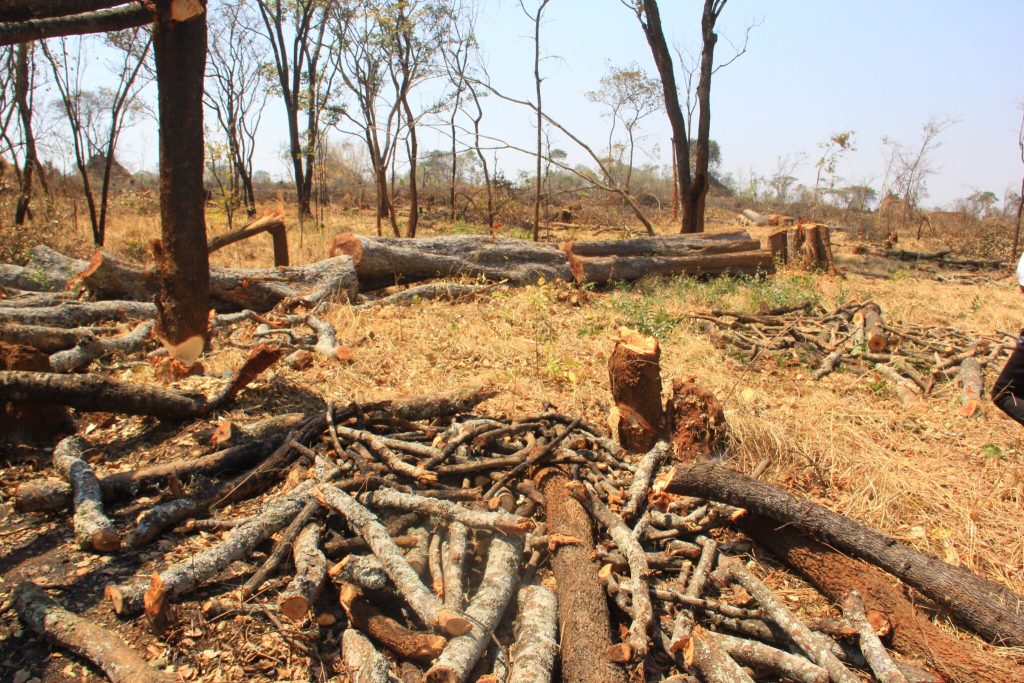
Field investigation: Our journalist’s perspective
From August 21 to September 3, 2025, Apes Reporting Project and InfoNile’s senior reporter and coordinator for DR Congo, Jonas Kiriko, visited three villages in Haut-Katanga: Mwase, Mampa, and Mwawa, where community forests are facing pressure from mining. Before departure, a security plan was developed, which was further refined through training provided by a security expert in the Congo Basin.
This plan proved crucial, first and foremost, to protect sources. In these isolated areas, lacking police and infrastructure, the safety of the communities is essential for the journalist’s safety.
One of the anticipated risks was crossing military checkpoints, particularly on the roads to Sakania and Kipushi, which are manned by the presidential guard, a unit of the Congolese national army. Officially, their deployment to these checkpoints is justified under the fight against mineral smuggling and against any infiltration of the city of Lubumbashi by armed militias. Unofficially, these officers frequently harass passersby by charging for passage at their various checkpoints.
The choice of a Land Cruiser, a vehicle often associated with authorities and non-governmental organizations, allowed him to avoid the searches and extortion to which these soldiers frequently subject travelers. Every time his vehicle approached a checkpoint, the soldiers guarding it let him through. At every road tollbooth, he didn’t pay at all.
Local sources revealed that Land Cruiser vehicles are known in the area for transporting public officials and “important people,” including mine owners, politicians and army generals. Therefore, allowing him free passage was intended to prevent him from witnessing the harassment that the military often inflicts on passersby. It also gave him a sense of the privileges and impunity enjoyed by certain individuals in this region, including mine owners.
Communities not consulted
DRC’s mining code requires all companies to consult with local communities before undertaking any activity. But leaders and residents of several community forests that InfoNile visited in Haut-Katanga said they were not consulted by any of the mining companies that currently hold permits in their forests, leading to tensions between companies and communities.
In Mwawa, a village in the Katanda chiefdom on the Lubumbashi-Kasumbalesa road, more than 5,000 people live around the local community forest and depend on small-scale agriculture and charcoal production for their livelihoods, according to Mukasa Romain, a leader of the Mwawa community forest.
Six mining permits cover nearly half of this community forest, which was created in 2021. One permit was issued in March to LIDA SARL, another in 2023 to In Put Mining SARL. Three others, owned by the Compagnie Minière de Sakania SPRL, were issued in 2013 and were due to expire in 2018. At that time, they were converted from exploration to small-scale exploitation.

Early last year, about half a dozen residents accused another company, Boss Mining, of destroying their farmland while the company was carrying out exploration activities for copper and cobalt.
“I observed that Boss Mining conducted prospecting and then left. They destroyed crops such as cassava and maize,” Romain said.
Boss Mining is a joint venture between Eurasian Resources Group (ERG), 40% owned by the government of Kazakhstan, and the Congolese state-owned company Gécamines. The company, however, does not hold any permit in the community forest or in the surrounding area. According to Reuters, the government temporarily stopped Boss Mining from operating in the province in 2023 after a flood caused major pollution and “loss of life.”
Boss Mining did not respond to multiple requests for comment.
With an area of about 7,000 hectares, this forest is one of the open Miombo forests in Haut-Katanga, characterized by relatively small trees.

In nearby Mampa, nine mining permits cover the community forest. These include at least two five-year permits that were issued after the community forest’s establishment in 2021: Prometal SARL, which received its permit in June 2024, and LIDA SARL, which was also overlaps with Mwawa.
Banza Godefroid, the local president of the community forest, said no mining companies had requested access to their land for operations.
“If mining permits exist, perhaps they were issued in the provincial capital of Lubumbashi, where some people from our village have often impersonated representatives of the local population. This forest is our only resource, and we have no intention of giving it up to anyone,” he said.
In Mwase, seven permits have also been issued to explore or mine silver, barium, chromium, cobalt, copper, germanium, nickel, gold, lead and zinc. Five local leaders told us they were not aware of these permits.
Mwase community forest is situated in a region of the DRC (Haut-Katanga/Lualaba area) where Great Apes, particularly chimpanzees, are known to reside. Local residents around this community forest fear losing the last remaining land available for agriculture, as surrounding areas are already heavily occupied by mining concessions. This land squeeze does more than threaten food security; it forces community activities deeper into the core habitats of Great Apes. As local leaders retract forest lands to resell them for logging and industrial farming, the "buffer zones" that once protected resident chimpanzee and bonobo populations are vanishing, leaving these primates with nowhere to hide from human encroachment.
Along the road leading to the community forests of Mwase, Kete Kaisala and Kalunda, piles of excavated subsoil have formed artificial hills. These sites have begun to attract artisanal miners from Lubumbashi’s eastern peripheral neighborhoods, increasing environmental and social risks.

Environmental groups said the lack of consultation might increase conflicts. In Kisankala, a protest against exploitation of the COMIDE concession was violently repressed last year, with residents claiming they had never been consulted or involved in decisions regarding the occupation of their lands. Other demonstrations occurred recently in Lualaba and around the mining areas of Likasi, Kakanda, and Lubudi in Haut-Katanga.
Omer Kabasele Kabongo of Green wold Solidarity said that legally, the community must be at the “center” of mining company processes. Companies’ operating permits are only renewable if their holders commit to “respecting the conditions that define social responsibility towards local communities impacted by the project’s activities,” he said. If they do not, DRC mining law permits the state to suspend the companies’ activities, impose fines or withdraw their licenses.
Some Mwase residents expressed hopes that mining could open up the area and bring economic opportunity, given the dearth of schools, health centers, or roads. But there is no legal requirement for companies to compensate managers of community forests when they encroach on their lands, posing risks of exploitation.

Communities and companies sometimes develop informal agreements to resolve conflicts. These terms tend to favor companies and disadvantage communities, said Muswa Nzambi of the Union of Community Forest Concessions of Haut-Katanga.
“Two years ago, we dealt with a case concerning Golden [Sands Mining]. This company had agreed to pay $400 a month to the community, a paltry sum, for the entire duration of its operations. These commitments were made in the presence of environmental agents and other witnesses. But when the company no longer honors its commitments, and when we seek help from state services, there is no solution,” he said.
Scarron Bipomba, the company’s managing director, admitted it had halted payments to the community after a change in leadership. He promised to rectify the situation but did not specify a timeline or whether Golden Sands would pay arrears.
“We will relaunch the process. I have just taken office as the new managing director, and I will soon convene a meeting with representatives of the Kyunga community in order to resume the payments in accordance with the specifications,” Bipomba said.
Muswa Nzambi expressed frustration with the Congolese state for inaction.

“So which other state should we turn to? These communities are already poor, their biodiversity is at risk. They feel abandoned, left to the mercy of companies that do as they please. We have two major cases that remain unresolved. Yet, the state is aware of them. These cases have even reached Kinshasa, the seat of the country’s institutions. Why are they not being addressed?”
Yves Agwamba of CIFOR insisted that the mining and forestry services must improve communication to avoid overlaps between mining permits and community forests.
“This is property that belongs to the entire community. It cannot be sold or transferred,” he said.
Professor Maindo emphasized that public authorities should prioritize the creation of digital integrated databases, bringing together forestry, mining, and agricultural registries to provide universal access to permitting information from anywhere, thereby strengthening transparency.
Editing by Annika McGinnis and data support by Federico Acosta Rainis and Annika McGinnis.

