

Story by Fredrick Mugira
Visual maps and spatial data visualisations by Earth Insight
November 19, 2026
After a series of high-profile promises at COP17 in Yerevan and tough talk at COP31 in Antalya, the future of the Congo Basin hangs in the balance. Can international commitments actually make a difference in the forests and communities in the basin? On the ground, people are waiting to see if the world’s promises will finally turn into real protection.
In Antalya, the hardest bargains included tripling adaptation finance, transitioning the Adaptation Fund and setting guidance for the Loss and Damage Fund, among others. However, even in the corridors of the conference, civil society counted 103 delegations linked to major polluting companies and 30 of the world’s top 100 fossil-financing banks, which shows how contested forest and climate safeguards remain.
Yet the political deadlock in Antalya arrives just two weeks after a major biodiversity push in Yerevan, Armenia. At CBD COP17 in late October 2026, governments completed the first global review of the Kunming-Montreal Global Biodiversity Framework. They adopted the Yerevan Pathway, an urgent roadmap to accelerate nature protection and finance before 2030 after assessments found the world off track on most targets.
The Yerevan Pathway calls on leaders to stop funding activities that damage nature and to back up big promises with real money and clear rules. It’s about moving from talk to action, helping countries protect wildlife, support local communities, and measure whether their efforts are working.

For the Congo Basin, those priorities echo IUCN Resolution 8.137, a policy framework adopted by IUCN members. To maintain at least a 74% intactness threshold to prevent irreversible ecological damage and tipping points, leaders need to stop rewarding companies that clear land for logging or oil extraction. Instead, funding should flow to local communities who know the forest best. This means recognising and protecting the customary land rights of Indigenous Peoples and local communities rights to their land and ensuring that any plans to protect the forest are implemented on the ground, not just on paper.
Oil and gas blocks overlap 38 percent of the mapped community forest area in the Congo Basin, according to a report released at COP31 in Antalya by Earth Insight, the Global Alliance of Territorial Communities, Tenure Facility, Rights and Resources Initiative, Global Land Alliance and PINGO’s Forum. That overlap illustrates what is at stake as governments implement the Intergovernmental Land Tenure Commitment (ILTC), launched at COP30 in Belém. By 2030, signatory governments aim to recognise tenure rights across at least 80 million hectares in tropical forest countries and strengthen governance and protection across another 80 million hectares of already recognised lands.
In the Democratic Republic of the Congo, the national target is to secure land tenure rights for Indigenous Peoples and local communities across approximately 54 million hectares by 2030. One measure of progress beyond hectares recognised is how the DRC handles oil and gas concessions that overlap community forests. The report calls on governments to review concessions with affected communities, respect their right to free, prior and informed consent, and uphold territorial rights in licensing decisions. It also calls for direct, long-term funding so communities can govern and protect their forests.
These tests in Antalya and Yerevan carry immense stakes for the Congo Basin rainforest itself. Holding more than 100 billion metric tons of carbon and sheltering endemic wildlife, from the Cross River gorilla to forest elephants, the world’s second-largest tropical forest basin is edging toward an irreversible tipping point. Between 2001 and 2025, Congo Basin countries lost 34 million hectares of forest, roughly the size of the Republic of Congo, with more than a third of that loss occurring since 2020. Across Africa, 3.9 million hectares of forest disappear every year.

Pressures on the forest basin
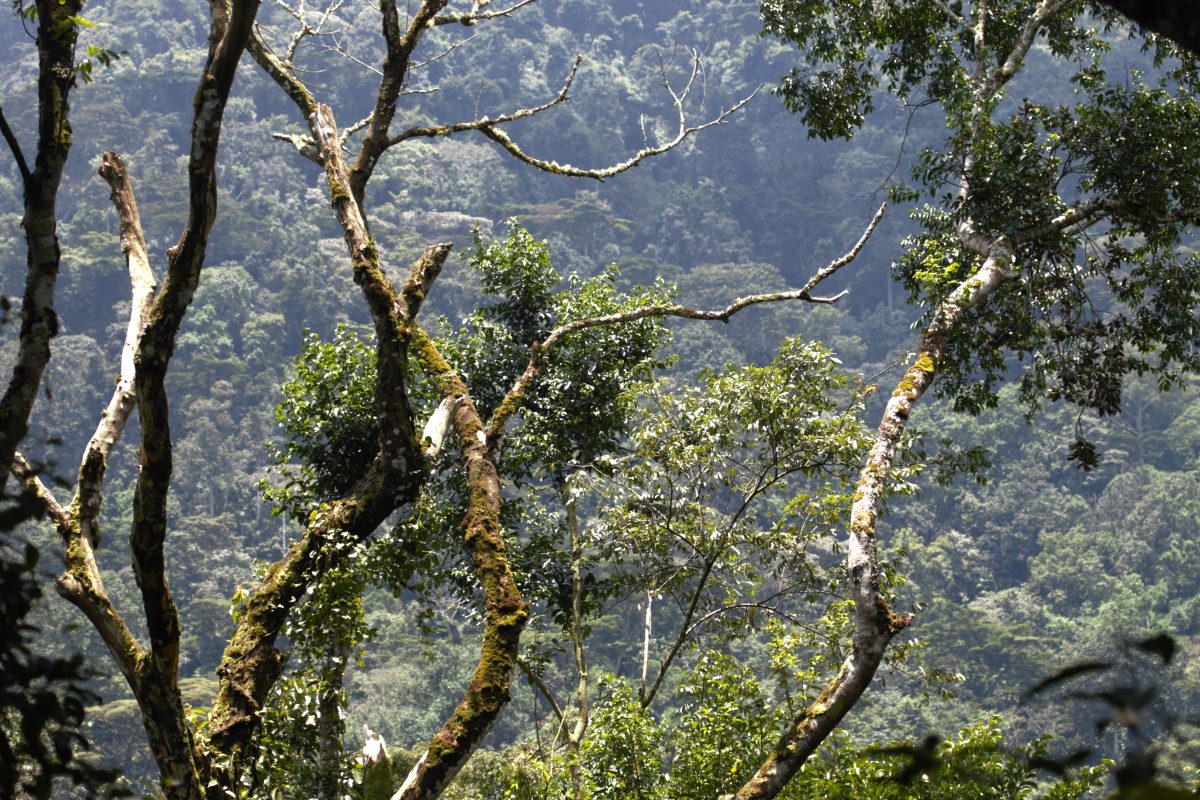
The Congo Basin isn’t just a forest. It’s a living, breathing shield against climate change, home to animals found nowhere else, and the source of water for millions.
Experts say these forests make their own rain. Cut down too many trees, and the region could dry up, turning lush jungle into grassland. The loss wouldn’t just be local. It could send billions of tons of carbon into the air and disrupt water supplies far beyond Central Africa.
Yet only 14 percent of dense humid forests in Central Africa have protected area status. As a result, governance gaps leave vast stretches exposed to infrastructure and extractive pressures.
Those pressures are accelerating on the ground. In the Democratic Republic of Congo, 55 oil blocks cover about 124 million hectares, more than half the country. They overlap with 8.3 million hectares of protected areas, 8.6 million hectares of Key Biodiversity Areas, 64 percent of the country’s intact forests, and nearly all mapped peatlands, affecting an estimated 39 million people.


In the Republic of Congo, two oil exploration blocks overlap more than half of Conkouati-Douli National Park’s terrestrial area and nearly 90 percent of its wetlands. That puts 900 Western lowland gorillas, 7,000 common chimpanzees, 900 African forest elephants and roughly 7,000 people who depend on the park at risk.

What IUCN Resolution 8.137 asks governments to do
Seeking stronger protection for the basin’s forests, more than 30 organisations across Africa, Latin America and North America, including AJESH (Ajemalebu Self Help), a civil society organisation that operates in Cameroon, Ghana, Tanzania and the USA, Earth Insight, the IUCN CEESP Natural Resource Governance Framework Working Group and REPALEAC, Network of Indigenous and Local Populations for the Sustainable Management of Forest Ecosystems in Central Africa, pushed forward Emergency Motion 140 to give governments and communities a stronger basis for protecting intact forests and high-integrity areas. In October 2025, the IUCN World Conservation Congress in Abu Dhabi adopted it as IUCN Resolution 8.137, building on Amazon tipping-point resolutions (7.129 and 8.067).
The resolution urges Congo Basin states, IUCN members and the IUCN Director General to take emergency measures to maintain the ecological integrity of the basin’s forests. It identifies a 74 percent intactness threshold for forests to avoid irreversible ecological damage and tipping points in the basin. The resolution also requests that IUCN members and relevant states work together to identify and adopt effective measures, including geographical exclusions of all extractive industries from intact and high-integrity areas.
The resolution also asks the IUCN Director General to set up a Congo Basin Tipping Point Assessment Task Force. This group would map risk hotspots, study ecological limits, and provide an interim science-based report by the end of 2028.
Finally, the resolution calls for building capacity in local organisations, supporting Indigenous and community monitoring, and creating finance packages that link nature and climate. It also stresses that financial flows should follow the precautionary principle. The goal is to make sure policy commitments turn into real-world protection on the ground.

Frontline and expert voices: Q&A
At CBD COP17 in Yerevan, Fredrick Mugira spoke with two key figures behind the resolution about how policy, science, and community rights can hold the line for the Congo Basin.
Florencia Librizzi
Deputy Director, Earth Insight, who co-led the drafting and negotiation of IUCN Motion 140. Florencia serves on IUCN’s commissions on environmental law and protected areas and teaches sustainability as an adjunct professor at Fordham’s Gabelli School of Business in New York.
Fredrick Mugira: Could you outline the core mechanics of IUCN Resolution 8.137 and what makes it a milestone for regional policy?
Florencia Librizzi: IUCN Resolution 8.137 was adopted at the World Conservation Congress in Abu Dhabi in October 2025. It emerged from an emergency motion advanced by more than 30 organisations, with leadership from AJESH, Earth Insight, the Chair of the IUCN CEESP Natural Resource Governance Framework Working Group, and REPALEAC. It calls for maintaining at least 74 percent forest intactness and excluding extractive industries from intact and high-integrity areas, giving governments and partners a clearer policy basis for protection and action.
Fredrick Mugira: How does this resolution inform land-use policy in countries like the Democratic Republic of Congo (DRC)?
Florencia Librizzi: The resolution provides a shared policy framework for governments, rights-holders, and conservation partners to advance stronger protection and finance. Beyond the region, it reinforces the idea that 30 percent must be a floor, not a ceiling. Ecosystems such as the Congo Basin and the Amazon require integrity and connectivity across much larger landscapes. In the DRC, however, 55 oil blocks cover approximately 124 million hectares (more than half the country, including much of its globally important peatlands), showing why stronger policy action is needed to protect these areas.
Fredrick Mugira: What are your primary policy recommendations for decision-makers at CBD COP17 and COP31?
Florencia Librizzi: Decision-makers across CBD COP17 and COP31 should draw on Resolution 8.137 to help prevent ecological tipping points. Governments should establish enforceable exclusions of incompatible extractive and large-scale industrial activities from protected and conserved areas, safeguard intact forests and peatlands, and review, retire, or phase out concessions that undermine conservation objectives. Implementation must respect free, prior and informed consent and directly fund Indigenous Peoples’ and local communities’ governance and stewardship, so policy becomes measurable protection and lasting benefit.

Dr. Agbor James Ayamba, Program Officer, AJESH AJESH (Ajemalebu Self Help), a civil society organisation that operates in Cameroon, Ghana, Tanzania and the USA
Fredrick Mugira: What prompted your organisation and partners to push for this report and emergency resolution last year?
Dr. Agbor James Ayamba: The Congo Basin faces severe, escalating threats from logging, oil and gas exploration, and mining. If care is not taken, it will go below the tipping point. Once it goes below the tipping point, it becomes catastrophic. The Congo Basin stores large amounts of carbon, harbors wildlife, and supports indigenous peoples and their livelihoods. To prevent it from reaching the tipping point, we need to act fast. If it gets destroyed, we are all doomed.
Fredrick Mugira: How are endemic wildlife species, particularly Great Apes like the Cross River gorilla, vulnerable to this shift?
Dr. Agbor James Ayamba: In Cameroon and Nigeria, we have the cross-river gorilla that is endemic to Cameroon and Nigeria. And these are iconic species. They have a role to play in forest regeneration, maintaining forest structure, and the rest. And if the forest is degraded or destroyed, where would these animals go? And these animals are strongly attached to the communities around them, to their cultural values, cultural life, way of life, and even their traditions. And to protect this wildlife, especially the cross-river gorilla, we need to protect the Congo Basin rainforest.
Fredrick Mugira: What concrete steps are being taken to turn Resolution 8.137 into enforceable action?
Dr. Agbor James Ayamba: We’re trying to put a task force in place to follow up on the resolution, and we’ve sent out questionnaires to governments and societies on the resolution, and we’ll be holding a webinar in a few days to discuss and also to see how we can set up some yardsticks which, in later years, we can use to measure. And for the report, we’ll be doing it in a year or two? So, for now, we want to see what we can do over the next two to three years so that, at the next IUCN Congress, we can present a certain level of achievement and progress. Cameroon has just signed the 30 by 30 initiative, taking one step toward protecting the Congo Basin. Secondly, we call on other governments within the Congo forest to also consider strategies to protect this forest and community lands. Development must be carried out with respect for free, prior, and informed consent, ensuring that conservation and community rights are twin brothers and that policy commitments produce practical results.
This story was produced as part of the 2026 CBD COP17 Fellowship, operated by Informed Earth in collaboration with Internews’ Earth Journalism Network. Visual maps and spatial data visualisations by Earth Insight

