
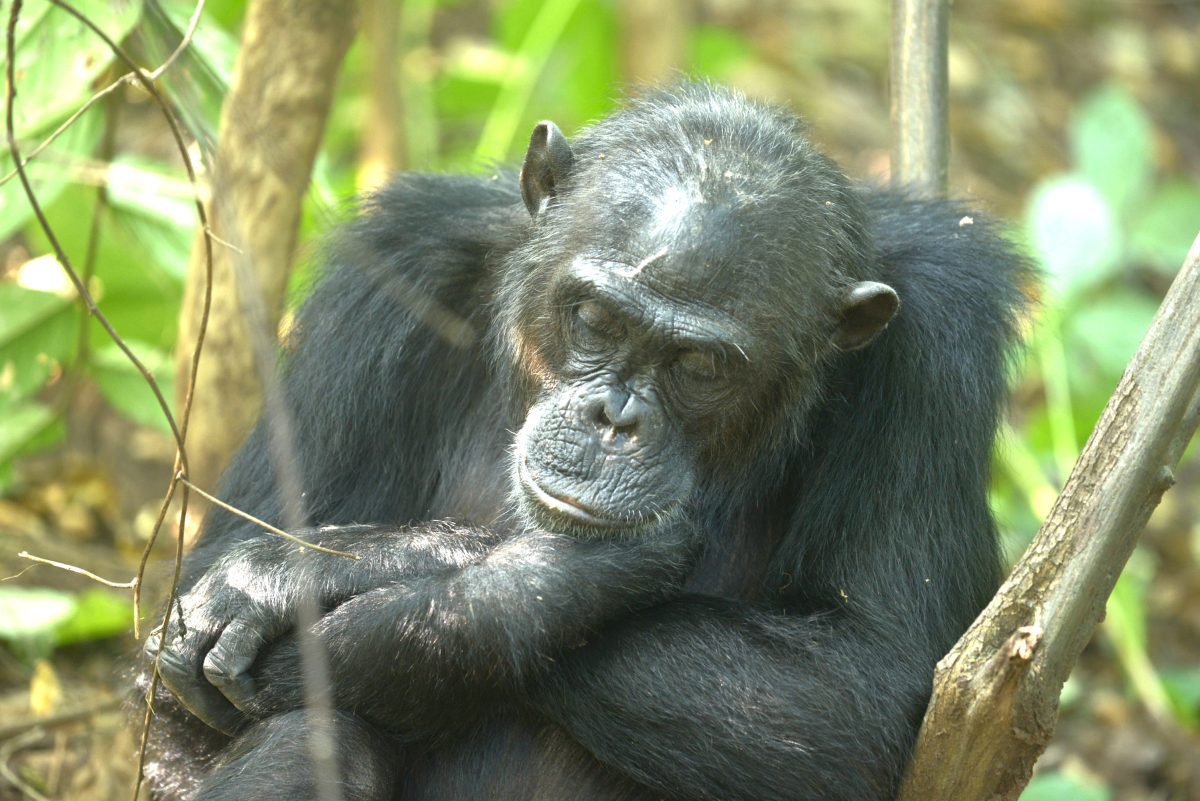

New investigation reveals how illegal logging for tea processing is destroying the high-canopy habitats essential for Burundi’s last wild chimpanzees. This story is part of a series of four investigations produced with the support of the Pulitzer Center.
By: Arthur Bizimana
The chimpanzees of Kibira National Park in Burundi are running out of forest, and time.
New data and field investigations reveal a catastrophic 60% decline in the park’s chimpanzee population, falling from roughly 500 individuals to just 200 in recent years. A battle for land is killing off the chimpanzees, as tea plantations push deeper into their forest home.
As industrial tea plantations expand and factories strip the forest for fuel, the great apes are being forced out of their shrinking canopy and into a dangerous, often fatal, proximity to the human communities surrounding the park.
With their habitat under threat, some chimpanzees tragically lost their lives, while the survivors were forced to abandon the Kibira areas, especially Rwegura, Teza, and Musigati. Seeking safety and a new home, they found refuge in the Mabayi area near Rwanda’s Nyungwe Forest. There, they search for food and try to stay safe, as described by Dismas Hakizimana, a researcher and lecturer at the University of Burundi, and Marie-Claude Huynen, a researcher and lecturer at the University of Liège. In their 2013 scientific article, “Chimpanzee (Pan troglodytes schweinfurthii) Population Density and Abundance in Kibira National Park, Burundi,” published by the University of Liège, the authors explain that chimpanzees are now more commonly found in the Mabayi sector—one of four sectors of Kibira that borders Rwanda’s Nyungwe National Park (NNP).
A Forest in Retreat
The crisis is rooted in a decades-long geographic squeeze. When Kibira was first designated a protected area in 1933, it spanned 90,000 hectares. Today, after decades of encroachment by the OTB (state-owned tea agency) and local agricultural expansion, the forest is a fragment of its former self. In 2019, the Burundi's Third National Communication (TNC) on Climate Change, a comprehensive technical report estimated the area of Kibira to be approximately 30,000 hectares.
In the shadows of the Kibira canopy, the OTB operates massive industrial blocks like Teza and Rwegura that push directly against the park's fragile boundaries. The agency is increasingly under fire for forest encroachment and for felling indigenous trees to fuel the wood-burning boilers essential for tea processing. This industrial siege continues despite the presence of the DPAE, REGIDESO, and ISABU—state institutions whose mandates for agricultural oversight, water security, and scientific conservation appear to have been sidelined in favor of industrial output.
"The boundaries have become invisible," says Nestor Mukasi, a local resident who has watched the tea rows march steadily toward the heart of the park. "The OTB sends workers to cut wood to dry the tea leaves, and where the trees fall, the tea bushes are planted."
This "invisible" expansion has created a double-edged sword for the ecosystem. To process green tea leaves into the black tea sold on global markets, massive industrial boilers require immense amounts of firewood. Much of this fuel is sourced—both legally and illegally—from the very trees that provide the chimpanzees with nesting sites and fruit.
From Canopies to Crops
The environmental thinning has triggered a desperate behavioral shift in the chimpanzees. Deprived of their natural food sources, the apes are descending from the hills to raid local farms.
What was once a rare occurrence has become a daily flashpoint for human-wildlife conflict. In neighboring villages, farmers like Jean Nyuzuriyeko now view the endangered apes not as national treasures, but as pests.
"They come for the potatoes, the cassava, the beans," Nyuzuriyeko says. "When the forest is empty, they have no choice but to take from us."
This migration for survival leaves the chimpanzees vulnerable. Outside the protection of the dense forest, they are frequently caught in snares intended for small game or killed in retaliatory attacks by farmers protecting their livelihoods.

According to environmental researchers and the state’s latest statistical data, the state-run tea office, known as the OTB, is systematically expanding cultivation into the borders of Kibira National Park.
The growth has been most aggressive in the Teza industrial block, where production more than doubled over the last decade, surging from 2,572 tons in 2013 to 5,433 tons last year. Nearby, the Buhoro complex saw a steady 12 percent increase.
The trend is further echoed in the Rwegura block, which saw production peak at 6,333 tons in 2020—a 13 percent rise—before a recent, sharp decline of 39 percent in 2023. This industrial surge, documented in a December 2024 report by the National Institute of Statistics (I.N.S.B.U.), confirms what conservationists have long feared: the "green leaf" is steadily swallowing the chimpanzees' last remaining sanctuary.
A Policy Blind Spot
Despite the visible decline, conservationists warn that a lack of updated data is masking the severity of the extinction risk. The last comprehensive government communication on climate change, released in 2019, estimated the park lost up to 12,000 hectares in a single decade.
"Kibira has become agricultural land in all but name," warns one park tracker, speaking on the condition of anonymity. "The state institutions meant to protect the land are often the ones clearing it for production."
Researchers at the University of Burundi, including Professor Richard Habonayo, argue that the current trajectory is unsustainable. While the tea industry is a pillar of Burundi’s fragile economy, the total collapse of the Kibira ecosystem would lead to the drying up of water sources that the tea plantations themselves—and millions of Burundians—rely on.

The Looming Silence
As the sun sets over the Rwegura sector, the once-deafening calls of chimpanzee groups are growing quieter.
Professor Habonayo calls for an immediate "red line" to be drawn—a hard boundary between industrial agro-complexes and the remaining primary forest. Without it, the "Price of Tea" may ultimately include the total extinction of the chimpanzee in Burundi, leaving the nation’s largest forest a silent monument to industrial expansion.

