
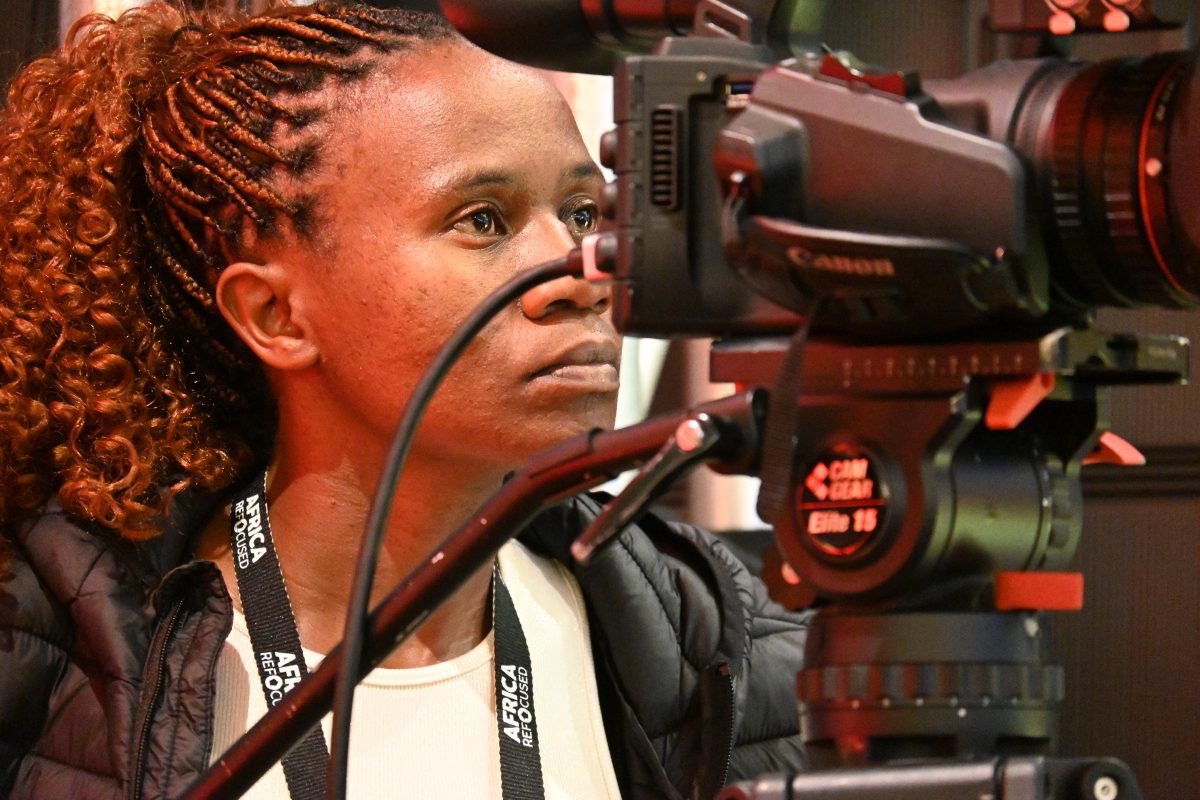

By Fredrick Mugira
For over eight years, Diana Kanweri has devoted herself to Kibale National Park in western Uganda, a place renowned for its chimpanzee population.
Within the park’s dense forests, Kanweri spends almost every day alongside these primates. As both a chimpanzee research assistant and a wildlife camera operator, she has created an extraordinary closeness with the chimpanzees, experiencing their world in ways few others can.
Kibale Forest National Park is home to more than 1,500 chimpanzees, which are organized into four separate communities.

If you have watched the “Chimp Empire,” the Netflix television series about Ngogo chimpanzees, you have likely seen Diana’s incredible work.
As the first Ugandan woman on the Ngogo Chimp Project, Diana’s camera captured the raw beauty and complex lives of these primates, scenes that touched hearts worldwide.
The Ngogo Chimpanzee Project, a research project, focuses on studying and protecting a group of chimpanzees living in Kibale National Park, Uganda.
Ben Sadd, the Chimp Empire’s Director of Photography, said Kanweri’s filming had a big impact on the documentary’s viewers. You can hear him talk about it on GLOBIO’s “Talking Apes” podcast (Sadd, Talking Apes). An article in British Cinematographer also noted how important Kanweri’s knowledge of the area and her filming skills were for “Chimp Empire.”
But Kanweri’s passion goes beyond filming. Seeing the dangers chimpanzees face, like getting caught in traps, led her to start Wildlife Next Door, a project that uses films in local languages to connect communities with wildlife. She believes that when people understand wild animals, they are more likely to protect them.
Recently, the Apes Reporting Project‘s Founder Fredrick Mugira, had the privilege of speaking with Kanweri at the eighth annual Nature, Environment and Wildlife Filmmakers (NEWF) Congress in Durban, South Africa. NEWF brings together storytellers, conservationists, and industry professionals from across Africa and beyond. Kanweri is a NEWF fellow. NEWF Congress is one of several initiatives supported by Africa Refocused – a collaboration between NEWF and the National Geographic Society.
In this conversation, Kanweri narrates the unforgettable moments shared with chimpanzees, the urgent threats they face, and the inspiring drive behind her conservation efforts.

You’re Diana Kanweri. What exactly do you do in the world of wildlife? My name is Diana Kanweri. I am a wildlife cinematographer, and I also work as a field assistant with the Ngogo Chimpanzee Project in Kibale National Park.
How long have you been working with wildlife? I’ve been working in wildlife for about eight years now.
What sparked your interest in wildlife, especially since you didn’t grow up around it? I liked wildlife because I grew up in an area where it wasn’t really a focus. It wasn’t seen as something people wanted to care for. But when I moved to Kibale, I realized I really wanted to be part of wildlife protection and do anything related to it.
How did you end up working with chimpanzees specifically? I joined the chimpanzees somewhat by chance. I didn’t know exactly what I wanted to do initially. But chimpanzees themselves are such amazing creatures. Just spending time with them makes you feel like you want to stay. It was about curiosity and watching what they do every day that I found fascinating. And I just stayed because every day feels like there’s more to learn and explore.
You mentioned it feels more like an adventure than work. What makes it so captivating? It’s not like work at all! It’s like an adventure. There’s a lot to learn and explore with them every day.
Wildlife fields are often seen as mostly for men. What has your experience been like as a woman in this field? This field is traditionally perceived as male-dominated, but I haven’t really looked at it that way. To me, it was just about walking into wildlife. I focused on dealing with nature, looking at the animals – monkeys, chimpanzees, all sorts of wildlife really interested me. I really love them. I started as the only female field assistant on this project, the first one ever employed. My attitude was that I wanted to do this, so I didn’t pity myself or think I couldn’t do it. Yes, I knew it would be hard, but I was determined. I just went out, did what everyone else did, carried what everyone else carried, and got it done. Every day, it became something I got used to, and I loved it.
What would you say to other women who dream of working in wildlife? For any woman out there who wants to pursue their dreams and passions working in wildlife, I think it’s just get out there and get yourself used to it. Sometimes you don’t know what you want until you see it. So, go to places near you, or even move out of your area if you can, and go into those places. Talk to people, because they can often lead you to what you want. Give it a try. Sometimes you can volunteer, even without pay, just to get yourself there. Wildlife is beautiful and amazing, with lots of diversity that can really grow you mentally. Just take a step and be prepared. Don’t listen to the voices that say you can’t do it. Just keep trying and don’t give up.
You worked on the Netflix series “Chimp Empire.” What was that experience like? My work with “Chimp Empire” was an incredible experience.
Can you share a particularly memorable moment you witnessed while filming? The most memorable moment for me was when I was out and found this very playful young chimpanzee, a male. He was resting, and then I saw him some distance away with a red duiker. Red duikers are a type of meat that chimpanzees eat. So when I saw the duiker walking close to the chimp, I thought, “Okay, roll camera.” In my head, I was sure the chimp was going to catch it, and I wanted to record it. But then, the duiker kept moving closer to the chimpanzee, who had his hand out, seemingly playing. The duiker came right up to him, started sniffing his hands, and eventually, they were just playing together! I never thought chimpanzees would pass up meat, especially duiker. That moment, with the chimp and the duiker just interacting peacefully, was so fascinating and impressive. I couldn’t believe it. It was something that doesn’t happen often. When I recorded it and told everyone, no one believed me until they saw the footage. I think that was the most exciting moment during the whole filming for me.

What makes chimpanzees so special to you? Being with chimpanzees in the forest every day is special and amazing. After being here for about eight years, it’s like you know every individual by name and by face. And you get the feeling they know you too because when they see you, they don’t seem shocked or scared. They just acknowledge you, like, “Oh, hey, there you are.” Every day, their ways, their actions, like babies playing, and watching adults do what they do is amazing. Chimpanzees do so many incredible things – their behaviors, how they live, interact, organize to protect their territories, and how they teach their young. It makes you wonder, who are chimps? Who are we to them? Sometimes I ask myself if we learned things from them or if they learned from us. Maybe we learned from them, copying everything. It’s everything about chimps, everything about being around them, the feeling of being accepted in their environment, staying with them every day – that’s like a gift I cherish.
You also mentioned conservation. How does your work contribute to protecting these animals? Staying with the chimpanzees for a while, just watching them and seeing how innocent they are, and then seeing some with snare injuries – some with no limbs, no hands, all kinds of impairments – is really impactful. Knowing chimpanzees and then suddenly they’re gone because of snares is so painful. Being in the forest with them for so long feels like a gift, and it made me think about how people outside don’t see or understand this. These injuries happen because people set snares in the forest, often for small animals, but chimpanzees become victims. This led me to start Wildlife Next Door community Organisation.
Tell us more about “Wildlife Next Door.” What is it? Wildlife Next Door is a project we run in the community that screens wildlife films, especially chimpanzee films. We go out to communities and have these films translated into local languages so people can understand them. The goal is to create empathy and an emotional connection so people learn who these animals are, beyond just seeing them as a nuisance that might raid their gardens. This is to promote awareness and ease conservation efforts. Often, when you tell farmers to protect chimpanzees, they only see the negative side because the chimps can damage their crops. We know the good side, so I wanted to build a bridge of understanding. They need to have knowledge about these animals so that when they encounter them, they have a different perspective and feel included in conservation. It’s not just about them being the ones who destroy or poach. The forests and the chimpanzees also survive because the people near the forests are, in many ways, protecting them. Wildlife Next Door aims to educate through films so people can see and understand, building awareness and hopefully inspiring future conservationists, filmmakers, and researchers from these communities.
Finally, what’s your message to women who are passionate about nature and conservation? For women who are passionate about nature and conservation, I want to say that it takes more than one person to conserve nature. If you have that passion, please nurture it. Take a step out there, look at the wildlife, look at nature, and see where your path might be. You might not connect with every animal, but there might be something you love that you haven’t discovered yet. Conservation needs all of us, so please take that step, reach out to as many people as you can, and keep talking about it. That makes a difference and can lead you to where you want to be. Speak up, make that move, and keep finding out. Read as much as you can because there’s so much knowledge in books about nature and conservation. And when you get a chance to be in the field, try to spread the message and inspire the people around you, especially those who don’t have the same opportunities to experience wildlife firsthand. Talk, take a step, and when you have the opportunity, inspire those around you. That’s it, thank you.


as a journalist and a photographer i was impressed with her work of photography.Nothing that makes me happy than producing the best scene through the lens